

It was only whilst en route to the fire that Dietmar Rall, Chief of the Pfullingen Fire Service, noticed the column of smoke rising above the town. The vehicles in the underground car park had probably not been on fire for long when the first firefighters arrived on scene. Yet the two blocks of flats above the underground car park were already engulfed in thick black smoke. Our magazine article summarises the insights gained from this operation.
The reason for the extreme amount of smoke came as a surprise
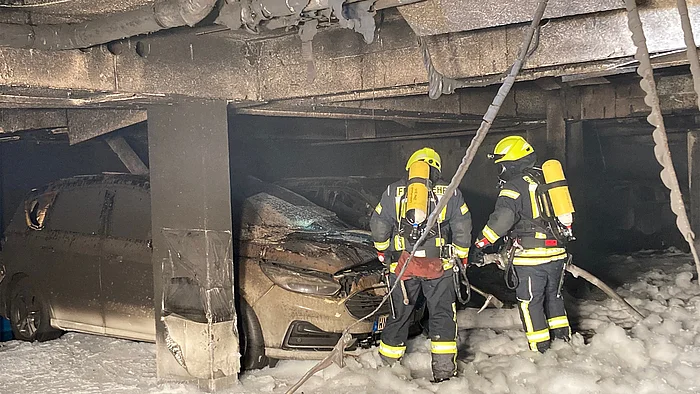
Speculation that an electric vehicle might have caught fire in the underground car park spread very quickly on social media. At first, Dietmar Rall thought there were ten or even more vehicles on fire, given the sheer volume of smoke. However, it later transpired that three burning cars of older model years, including a VW Beetle with a classic car number plate, were responsible for this unexpectedly heavy smoke. One can only imagine what the situation would have been like in the event of a fire involving modern vehicles, which have significantly higher fire loads.
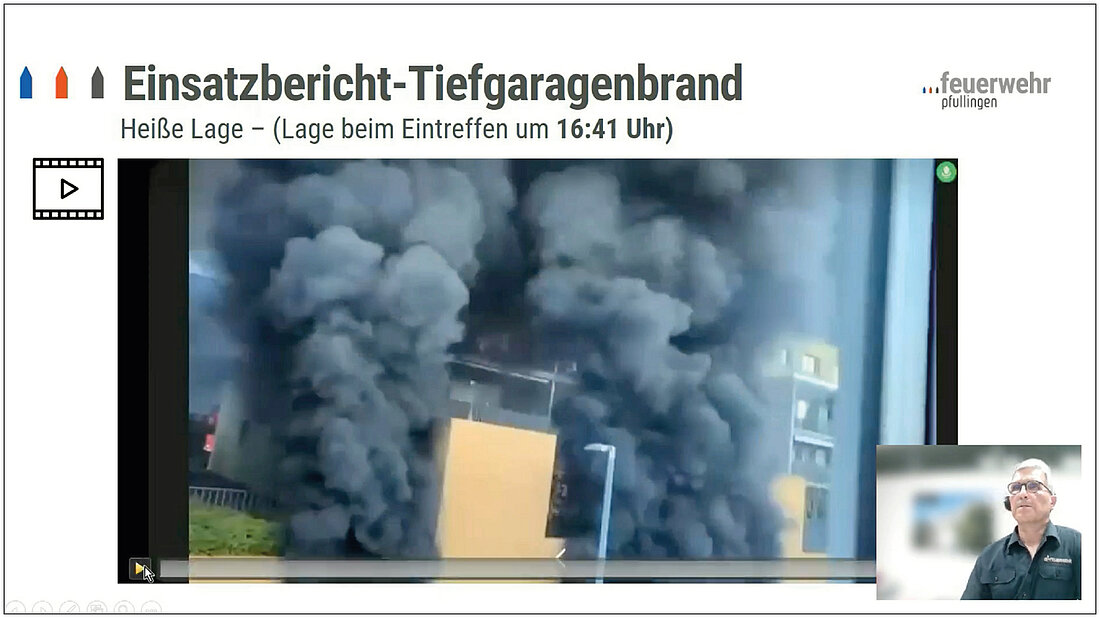
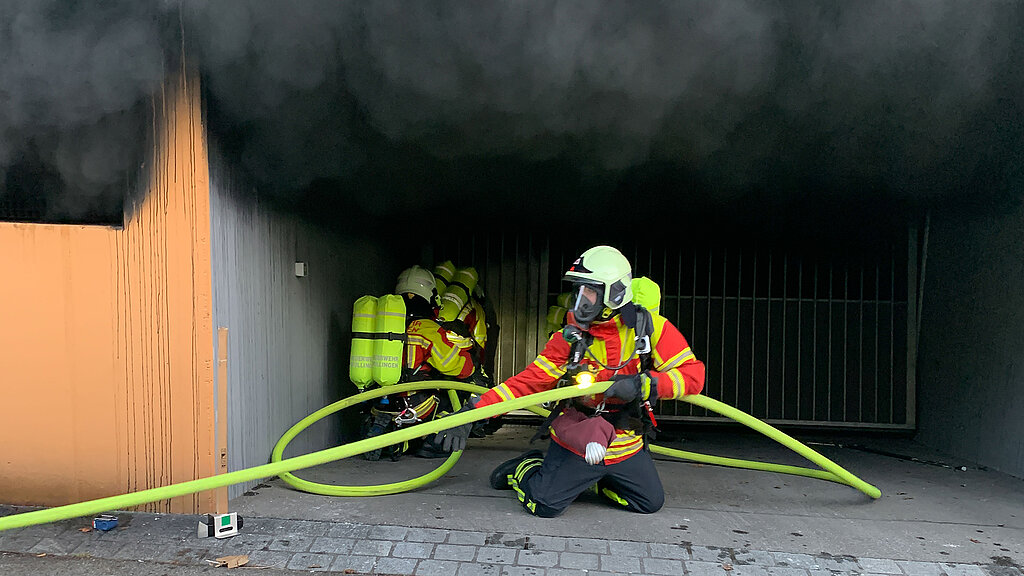
Smoke was billowing from the underground car park towards the building facades.
The underground car park has several smoke vents running along its entire length. Furthermore, the design appeared to facilitate the release of smoke and heat away from the blocks of flats situated above the underground car park in the event of a fire there. However, this expectation was not met. Within a short space of time, both buildings were engulfed in thick smoke. It was fortunate that the residents had kept all the windows closed because the temperature outside was 5 °C, and that the fire had not broken out at bedtime.
Two operational sections: underground car park and blocks of flats
At first, it was unclear to emergency services whether the main problem at the scene was the fire in the underground car park or the two residential buildings. The deputy head of the local German Red Cross Centre, who lived there, had already organised the evacuation of one of the two buildings. It seemed that most of the residents, at least, had left the second building as well. However, it was not certain that no one remained inside any of the buildings. Furthermore, it was not possible to assess the situation in the stairwells from outside. A turntable ladder was therefore provided as a second escape route.
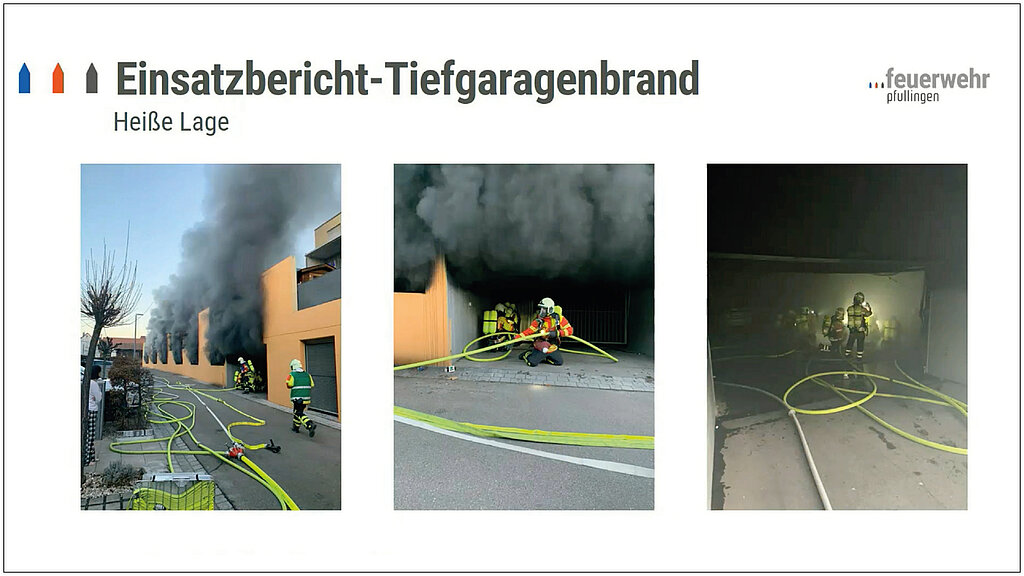
Two access routes to the houses made it difficult to organise the fire scene
The entrances to the buildings and to the communal underground car park are located on different streets in front of and behind the residential complex. The alarm was raised at the front of the building, where the entrances are located. Thanks to his knowledge of the area, Dietmar Rall was able to divert the first fire engine into the cul-de-sac leading to the underground car park entrance. Overall, the layout of the area proved challenging due to the confined space in the residential area, particularly for later-arriving reinforcement vehicles.
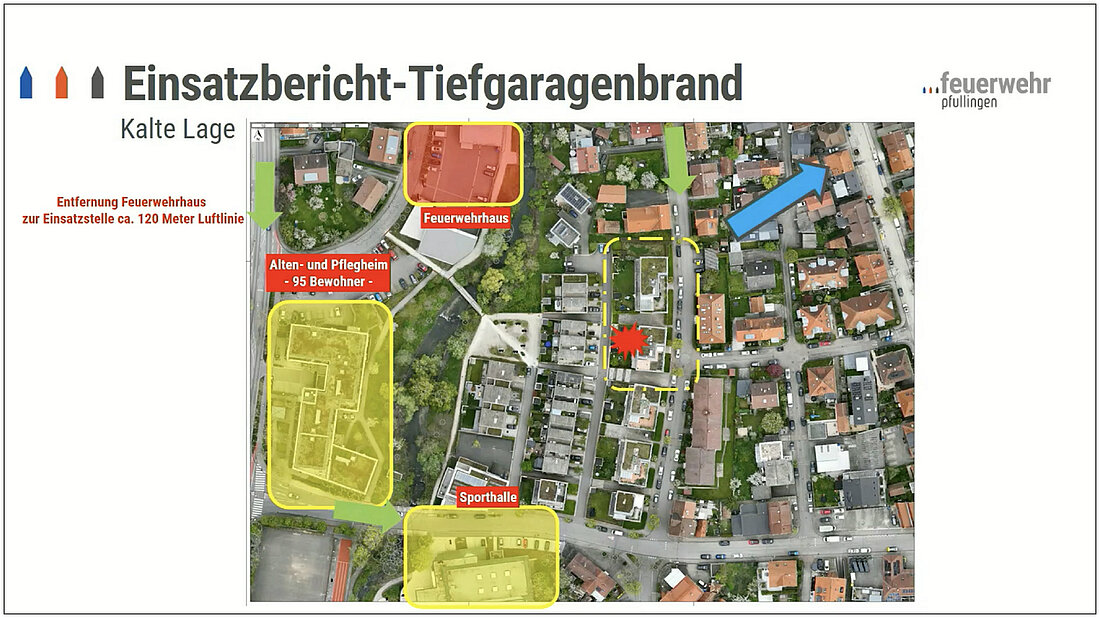
The wind direction prevented a critical situation from arising
Had the wind been coming from a different direction, the situation could have been far worse: In that case, a care home for the elderly with 95 places, a sports hall that was in use at the time of the incident, and the fire station might have been at risk – with far-reaching consequences.
Fire extinguished just 25 minutes after the alarm was raised
However, the conditions were favourable. The circumstance also applied to the location of the burning vehicles in the underground car park: They were parked in the parking bays near the entrance. A team leader, who had just completed the Intensive Underground Car Park Course at the International Fire Academy, led four team members – all wearing BAs and laying down two lines – into the fire to tackle the blaze. Twenty-five minutes after the alarm was raised, «fire out» was reported.
Extent of the damage
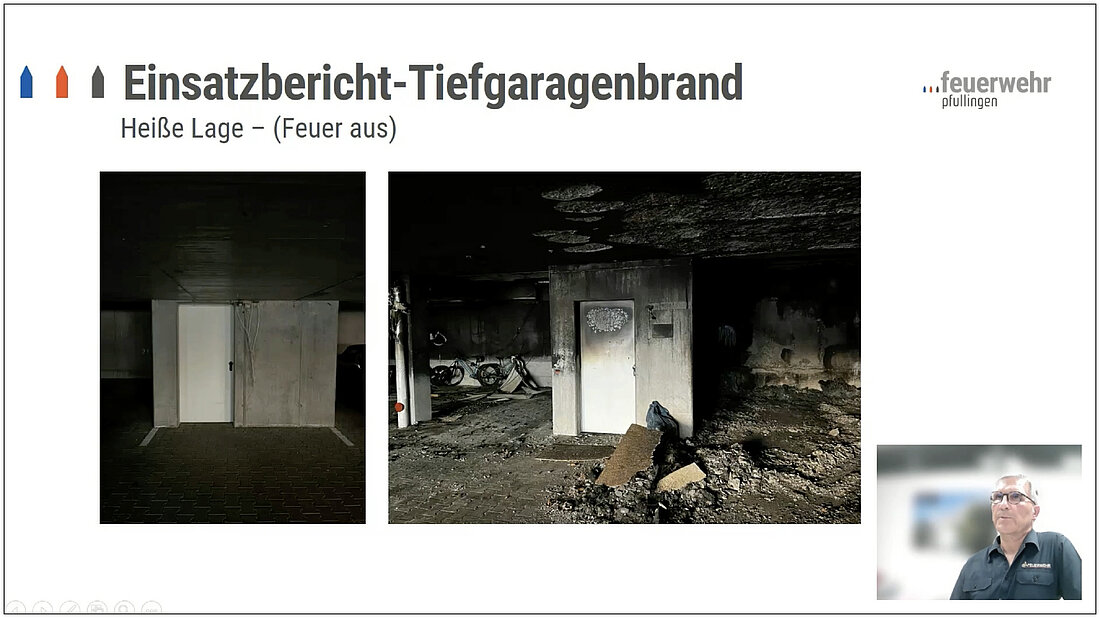
For the operation, it was important to have the electricity and gas supplies cut off via the utility companies. The damage revealed not only significant spalling of the underground car park ceiling, but also electrical wiring hanging down from the ceiling, which could have endangered the firefighters. A total of three cars were burnt out, whilst twelve others were damaged, some of them severely. The total damage is estimated at between 500 000 and 1 million euros. Just under a year and a half after the fire, the restoration work has still not been completed.
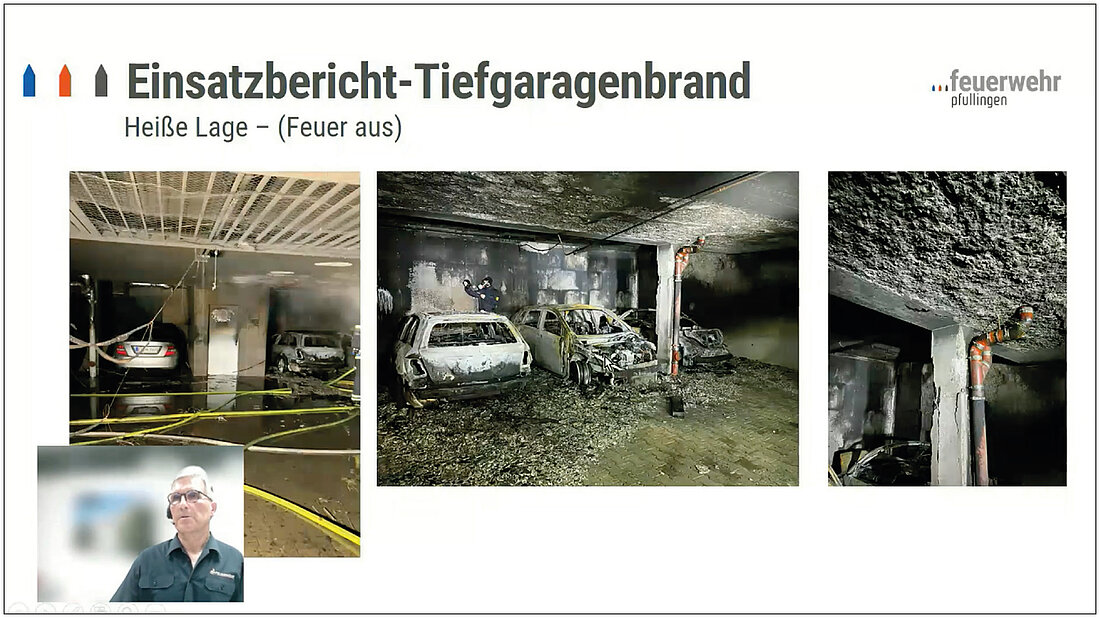
Flats remained smoke-free
The fire doors in the underground car park withstood the stresses. Positive-pressure ventilation at the building entrance provided additional protection against smoke ingress into the stairwell. The flats also remained smoke-free, meaning residents could return to the buildings – which had been checked beforehand – after two hours. The smoke extraction from the underground car park, achieved by forcing air in at one end and using extractor fans at the opposite end, proved to be very effective within a short space of time thanks to the favourable structural conditions.
The Pfullingen Fire Service (two firefighting platoons) was supported during this operation by the Reutlingen Fire Service (one firefighting platoon and a BA roll-off container ), the Metzingen Fire Service (LUF for smoke extraction from the underground car park) and the Lichtenstein Fire Service (staffing the Pfullingen fire station), as well as the deputy district fire chief.